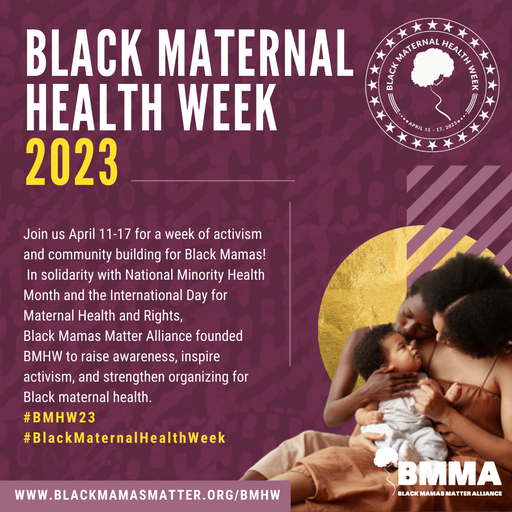
This day, April 11th, marks two important events in the work to eliminate global maternal mortality…
The first day of Black Maternal Health Week!!
The International Day for Maternal Health and Rights!!
Breastfeeding, chestfeeding, and human milk feeding play a vital role in supporting maternal and infant health and impacts health across the lifespan of both the parent and child! Yet, access to support that lactating parents need to initiate and sustain lactation is not equitable. It is evident in the location of hospitals with support for breastfeeding; in the biased assumptions of healthcare workers that Black mothers do not breastfeed; in the welcoming spaces for Black lactating families in the community. As a community, we need to ensure that Black and Brown families who wish to chestfeed, breastfeed, and provide human milk for their children receive the resources, support, and love they need to be successful and that our community welcomes Black lactating families.
To Honor and Celebrate this important Day and Week Learn More!
Black Maternal Health Week 2026 and Black Mamas Matter Alliance
International Day for Maternal Health and Rights
Lactation Support and Maternal Health
And don’t miss out on the Equity Before Birth 5th Annual Dance Party, Friday, April 17th
at the Museum of Life and Science, Durham, NC
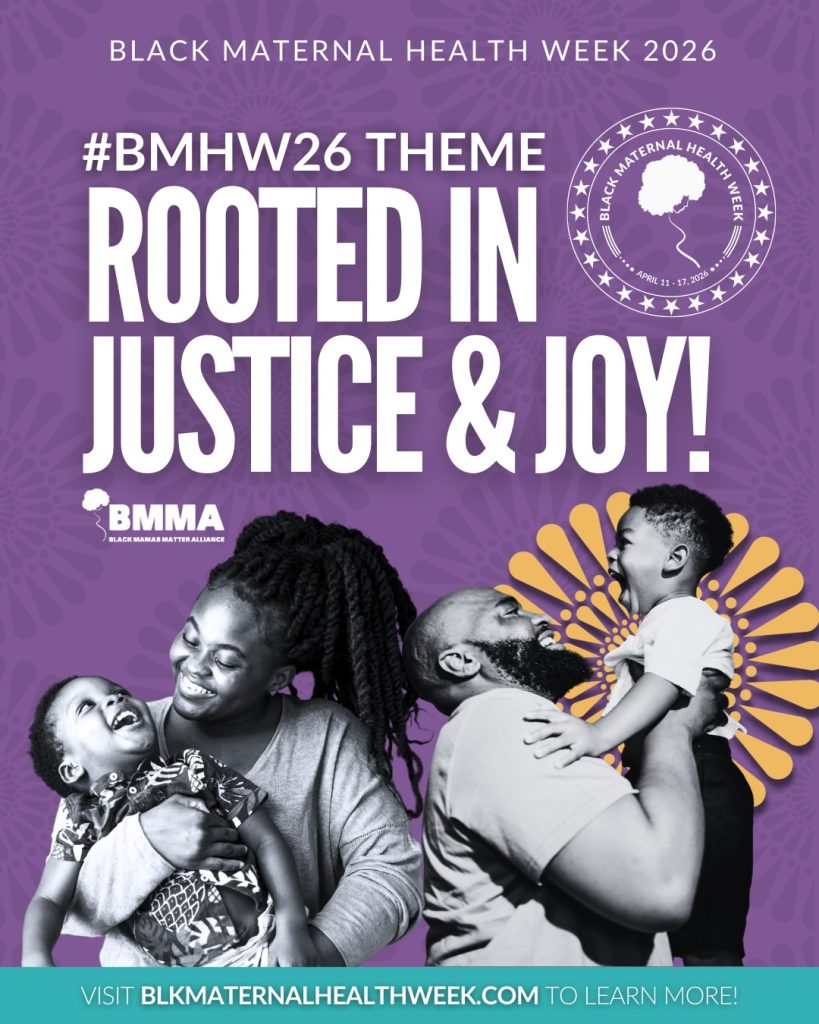
Black Maternal Health Week 2026
#BMHW26 Theme
Rooted in Justice & Joy!
Founded and led by Black Mamas Matter Alliance (BMMA) to “build awareness, foster activism, and community-building, amplifying the voices, perspectives, and lived experiences of Black Mamas and birthing people.”
Learn More and Get Engaged #BMHW26

International Day for Maternal Health and Rights
Partnership for Maternal, Newborn, and Child Health (PMNCH), April 11th
When we celebrate every person’s right to respectful, quality, safe, and comprehensive maternal health care. “A continent that cannot protect its mothers and children cannot claim full sovereignty over its future.” Dr. Jean Kaseya, Plenary IMNHC 2026
It’s a Dance Party!
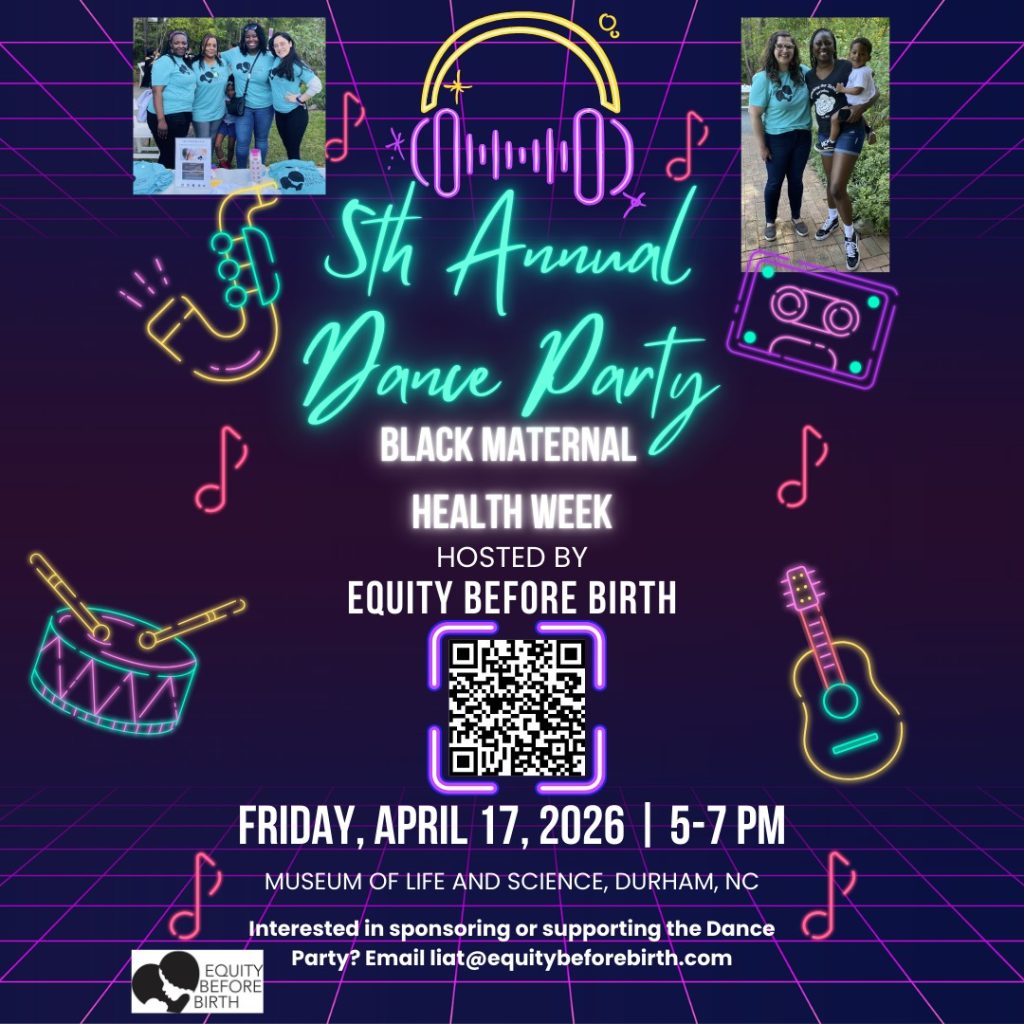
Equity Before Birth
5th Annual Dance Party
Friday, April 17, 2026
5–7 PM
Museum of Life and Science
433 W. Murray Avenue, Durham, NC 27704
…Reserve your FREE ticket by scanning the QR code or clicking the link (https://donorbox.org/events/915182/steps/choose_tickets)
Equity Before Birth
Learn More about Lactation Support and Maternal Health!
We offer resources to build awareness, promote activism, and build a welcoming, supportive community.
Ifeyinwa V Asiodu, Kimarie Bugg, Aunchalee EL Palmquist. Achieving Breastfeeding Equity and Justice in Black Communities: Past, Present, and Future. Breastfeeding Medicine 2021 Jun 7;16(6):447–451. (https://pmc.ncbi.nlm.nih.gov/articles/PMC8418442/)
• “Breastfeeding is protective of maternal and infant health across the life course. Increasing breastfeeding rates in Black communities is an important public health strategy to address maternal and infant mortality and morbidity…
• Yet breastfeeding disparities and inequities in Black communities persist. Systemic and structural barriers, such as racism, bias, and inequitable access to lactation resources and support continue to be issues in the United States…
• Going forward, significant investments are needed to decolonize breastfeeding research and clinical practice. Public health and policy priorities need to center on listening to Black women, and funding Black, Indigenous, and People of Color (BIPOC) organizations and researchers conducting innovative projects and research.”
(Learn More: https://journals.law.harvard.edu/lpr/wp-content/uploads/sites/89/2020/11/BMMA-Research-Working-Group.pdf)
Karen Robinson, Alissa Fial, Lisa Hanson. Racism, Bias, and Discrimination as Modifiable Barriers to Breastfeeding for African American Women: A Scoping Review of the Literature. Journal of Midwifery Womens Health 2019 Nov;64(6):734-742. (https://pubmed.ncbi.nlm.nih.gov/31710173/)
• “African American women’s experiences of racism adversely affected both breastfeeding initiation and duration.
• Health care providers’ biased assumption that African American women would not breastfeed affected the quality of breastfeeding support provided to them. Specifically, African American women received fewer referrals for lactation support and more limited assistance when problems developed.
• This scoping review provides evidence that African American women experience racism, bias, and discrimination affecting breastfeeding care, support, and outcomes.“
Race Forward [Center for Social Inclusion]. Removing Barriers to Breastfeeding: A Structural Race Analysis of First Food. 2015. (https://www.raceforward.org/system/files/pdf/reports/2015/CSI-Removing-Barriers-to-Breastfeeding-REPORT.pdf)
• “We seek policy interventions that truly address the root causes that are linked to breastfeeding outcomes, especially lower rates for women of color…
• No single policy alone can dismantle structural inequity. This takes reform, including diversification of the medical sector and those providing services, as well as changes to and better implementation and promotion of existing policies…
• But it also takes transformation, including directing funding streams to challenge all barriers at the neighborhood level.“